Energy
A reduced carbon footprint is integral to Freiburg's environmental commitment, and energy efficiency and alternative energy technologies are the primary pathways by which Freiburg has chosen to make progress in this direction. Since 1986, Freiburg has reduced its CO2 emissions by more than 20% (2007 data). Although an unusual reduction in car use and ownership plays an important part in Freiburg's achievements, Freiburg gains much of its recognition through its expansive and well-integrated solar sector.
Image Source: Solar Region Freiburg
Solar energy is integral to Freiburg’s identity and branding. Freiburg is widely known as a Solar Region both a reference to the amount of sunlight Freiburg receives and its achievements in photovoltaic’s (PV). Solar energy has become integral to Freiburg’s economy, planning strategy and has become a major cultural aspect among Freiburg’s citizens. Freiburg has over 13,000 square meters of PV installations, notably:
-35 out of the 70 municipal schools have installed PV systems, some also solar thermal water heating.
-The world's first football stadium with solar equipment – it has installed a large solar PV array on its roof, generating a total of 290 kW, and has some 60 m2 of thermal collectors for showers
-Freiburg's Central Station has a solar PV facade that is 19 floors tall, with 240 solar modules - The University Hospital Cafeteria has a 272 m2 solar thermal equipment, for their kitchen and dishwashing
-The Exhibition and Trade Fair which hosted Europe's largest solar trade fair Intersolar over last few years has a 440 kW solar panel on its roof and an extra 254 kWp on the recent extension of exhibition halls.
Freiburg is also a major hub of solar innovation. The Freunhofer Institute for Solar Energy Systems in Freiburg is the largest solar research institute in Germany and one of the largest in Europe, and Freiburg annually hosts Europe's largest solar fair, attracting visitors, scientists and politicians from around the world.
Solar Economy
The solar sector in Freiburg employs some 1,000 residents and generates revenue for the city annually in the form of tourism and industry. Furthermore, Freiburg’s reputation as a pioneer in the field of Solar has been a major attraction to tourists.
Solar energy is central to Freiburg’s sustainable economy. Although Freiburg has favorable conditions for solar energy, being one of the sunniest cities in Germany, it has also taken unusual initiative to incorporate solar efforts into its culture and economic vitality and culture. Freiburg is home of the Frauenhofer Institute of solar energy, the largest solar research institute in Europe. It is also home of the heliotrope, the world’s first energy self-sustaining building, the Solar Factory, and the world’s first soccer stadium to have its own solar plant. Furthermore, solar panels exist widely on the city hall, schools, churches and private homes.
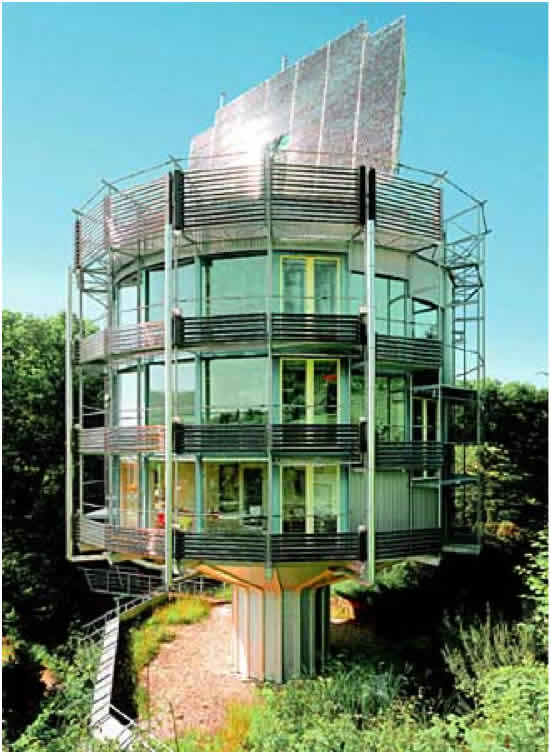
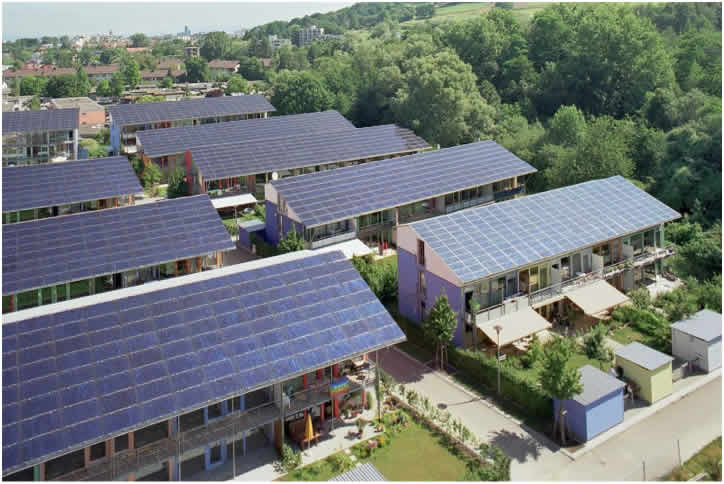
Freiburg's Heliotrope, the world's first completely solar powered building, and solar installations on housing
Photo Source: Solar Region Freiburg
Diversification
Solar only accounts for 5% of energy used in Freiburg. A local gas power plant, nuclear and imported energy make up the rest. Moreover, the majority of Freiburg's energy use reductions over the last few decades can be traced to cogeneration; almost 50% of Freiburg's electricity is supplied through a cogeneration steam and gas plant.
Freiburg’s energy sector is diversified. Efficiency measures extend beyond solar energy generation, and include a number of additional innovative energy-saving mechanisms such as passive solar home technology and geothermal energy. Freiburg is also actively trying to expand its wind sector, but progress on this front is in gridlock due to public opposition.
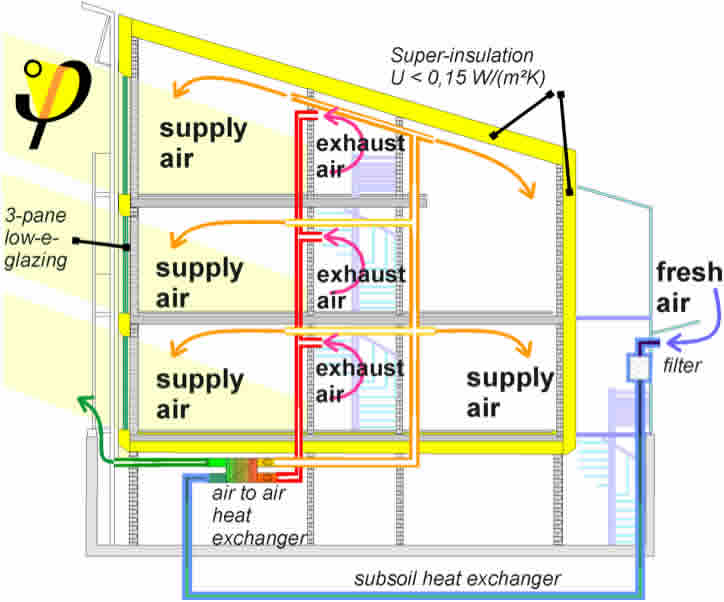
Passive home technology-- 3% more expensive to build, 30% CO2 emission reductions
Image Source: Dr. Wolfgang Feist; Passive House Institute
Mechanisms
Under the German federal government's 2001 Renewable Energy Law, energy companies are obliged to reimburse stored solar energy producers at a highly subsidized price. The federal government has also instituted a feed-in tariff system, whereby the federal government encourages investment in renewable energy systems by mandating utilities to buy excess renewable energy generated at above market rates. On the regional level, the Freiburg has taken several actions to expand the use of PV cells and sustain its "solar economy". In 1992, Freiburg became the first city in Germany to introduce a linear time-variable electricity tariff, which provides incentives to conserve energy by subsidizing the energy costs of residents with low consumption. These local efforts help maintain a market for PV cells, and thereby feed back into the local economy. (REACT - renewable energy action)